All articles
10
min
ISO 42001

ISO 42001 requirements - Chapter 5: IA Leadership and Governance

From strategic context to governance

Following on from the strategic analysis in Chapter 4 - Organizational Context, Chapter 5 of ISO/IEC 42001 gives concrete expression to this thinking by requiring active and committed governance from management.
Without this leadership, the Artificial Intelligence Management System (AIMS) can neither align with the overall strategy nor achieve the expected results.

Leadership rests on three essential pillars:
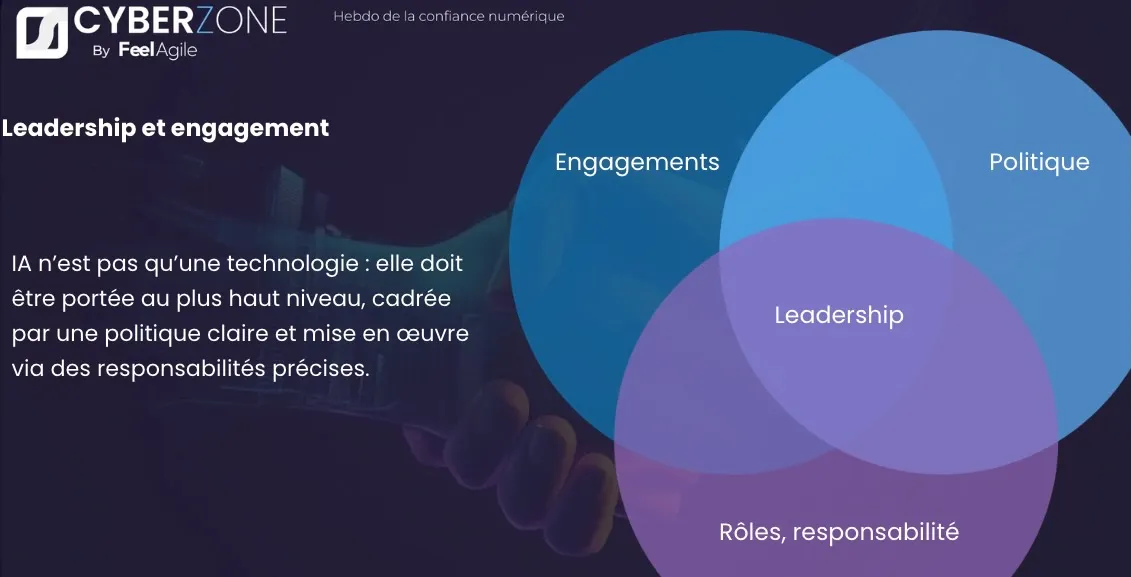
  1. Management commitment and exemplarity (5.1)
  2. A clear, consistent AI policy (5.2)
  3. Formally assigned roles and responsibilities (5.3)

Three pillars of leadership

Through these actions, management will provide direction (high-level objectives) and define the operating framework (steering structures).

5.1 - Leadership and commitment

Key requirements

Management must lead by example and take responsibility for the MIMS by :

  • ensuring that the AI policy (5.2) and AI objectives (6.2) exist and are consistent with the organization's strategic direction;
  • integrating MIMS requirements into existing business processes;
  • providing the necessary resources ;
  • explaining the importance of effective AI management and compliance with SMIA requirements;
  • ensuring that the MIMS achieves its intended results;
  • supporting and mobilizing people to contribute to its effectiveness;
  • encouraging continuous improvement;
  • supporting other relevant roles in their own leadership roles.

The notion of "business" is broadly understood (activities at the heart of the company's raison d'être). A credible leadership in AI implies the installation of a responsible culture: management must promote responsibility, transparency and ethical compliance in all uses of artificial intelligence.

Explanation

Top management's commitment is not just symbolic: it is reflected in decisions, resources, priorities and clear communication.

In concrete terms :

  • the SMIA must live within the processes (product, data, legal, purchasing, security, HR), not alongside them
  • management sets the course (objectives, risk thresholds) and monitors progress (indicators, management reviews, improvements)
  • the corporate culture must make it a matter of course to take account of impacts, ethics, safety and compliance IA
  • resources are defined and allocated in line with objectives

Examples of actions

This leadership must be reflected in all the company's actions.

  • Set up a monthly IA steering committee for the project
  • Start collecting project or AI indicators
  • Raising team awareness of AI (at all levels)
  • Define a project budget
  • Internal communications: launch, messages
  • Quarterly management review during the project

5.2 - AI policy

Key requirements

Management establishes an AI policy that :

  • is adapted to the organization's purpose;
  • provides the framework for defining IA objectives (6.2) ;
  • acknowledges the commitment to comply with applicable requirements (legal, contractual, internal);
  • acknowledges SMIA's commitment tocontinuous improvement.

This policy must :

  • exist in documented information;
  • link with other policies (information security, data protection, quality, CSR, ethics, product) where relevant;
  • be distributed internally;
  • be made accessible to interested parties, where appropriate.

Control objectives and reference controls for establishing the policy are given in Appendix A.2 (implementation guidance in Appendix B.2). Useful governance considerations are proposed in ISO/IEC 38507.

Explanation

The AI policy is the overarching framework: it formalizes the purpose of AI in the organization, the principles of responsibility (fairness, robustness, security, privacy, transparency/explicability), the governance model,risk appetite and goal framework. It creates alignment between strategy, compliance and operations.

Examples & practical advice

  • Document plan: Explanation of scope and objectives (high level), description of roles, important objectives according to criteria (fairness, security, robustness, privacy, maintainability, etc.).
  • Description of the SMIA framework: Risk analysis and review, definition of objectives, improvement...
  • At a minimum, the document must be formally validated by management.
  • Consistency: refer to RGPD policies, or standards, best practices you want to use

5.3 - Roles, responsibilities and authorities

Key requirements

Management ensures that the relevant roles are assigned and communicated, along with their responsibilities and powers. It formally designates who is responsible for :

  • SMIA compliance with standard requirements;
  • reporting on MIMS performance to management.

A reference control for defining and allocating roles and responsibilities is given in A.3.2 (guidance in B.3.2).

Explanation

There needs to be a clear definition of responsibilities throughout the IA lifecycle, and a management representative for the IAMS (like other management systems). Authority must be real: the ability to block non-compliant deployment, impose remedies, prioritize actions.

Examples & practical advice

  • We recommend formalizing roles clearly, with job descriptions or mission statements for all key roles (CTO, DPO, RSSI, R SMIA, etc.).
  • Possible deliverables: IA governance organization chart, role sheets, delegated powers, RACI matrix, escalation procedure, decision circuit.
  • Set up quarterly reporting in the monthly project phase: project progress, status of IA or safety objectives, action tracking, etc.

Conclusion

Chapter 5 transforms intention into governance, and provides the framework: leadership from the top, a clear AI policy and explicit responsibilities. With these three pillars, the organization can then plan (Chap. 6), provide resources (Chap. 7), implement (Chap. 8) and improve (Chap. 9-10) its AI system in a controlled and sustainable way.

➡️ Find out more about the following chapters.

Join our newsletter
Cybersecurity tips, analyses and news delivered to your inbox every month! 
Learn more about our privacy policies.
Thank you! Your submission has been received!
Oops! Something went wrong while submitting the form.
More content

Our latest Blog posts