Live Webinar - How to succeed in your ISO 27001 certification: the method in a live demo - Friday, October 16 at 2 p.m.
Sign up


If you wish to obtain ISO 42001:2023 certification, you will need to implement an Artificial Intelligence Management System (AIMS) .
ISO 42001 describes the structure of an AIMS, from planning and analysis to continuous improvement.
In this article, we will analyze clause 4 of the standard (management system clauses).
In this guide, we'll show you how to get started setting up an AI management system.
ISO/IEC 42001, the first international standard for the management of artificial intelligence, is based on a simple logic: before thinking about tools, security and models, we need to think about context and strategy.
Chapter 4 of the standard is central, as it defines how an organization must analyze its environment, stakeholders and responsibilities in order to build a robust AI project.
Let's take a closer look at how to use this chapter to build your strategy.
The first requirement is to identify the external and internal issues that may influence your ability to achieve the objectives of your AI management system.
This goes far beyond a simple diagnosis: it's a strategic analysis.
A highlight of the standard: you also need to determine whether climate change is a relevant issue. This may concern, for example, the energy footprint of the AI models used.
Finally, you need to clarify your roles vis-à-vis AI systems: are you a developer, supplier, integrator, user?
This identification is essential, as responsibilities and obligations vary according to role.
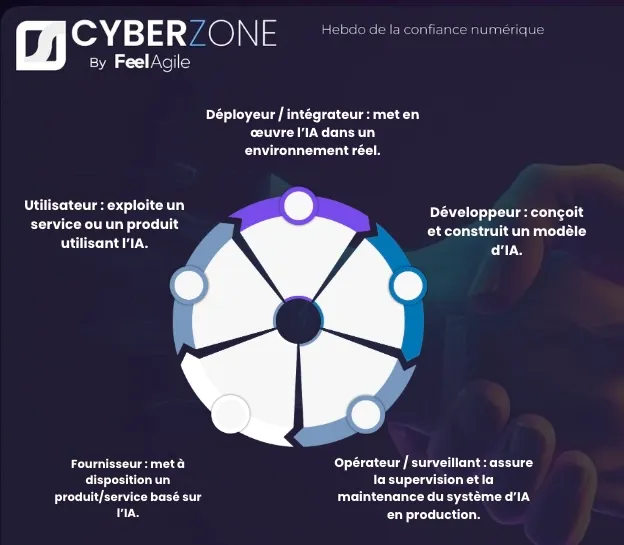
For your ISO 42001 certification, you can choose the role(s) you want to master.
Some examples of roles :
This means you can use ISO 42001 for internal management purposes only, or for your products.
The organization must :
Note: some stakeholders may also have expectations or requirements related to climate change.
Step two: identify the stakeholders who count in your AI ecosystem, and understand their expectations.
This includes :
The organization must then decide which requirements will be covered by the AI management system.
Example: a customer may demand explainable AI; an authority may impose the retention of audit logs; your teams may demand an internal charter of responsible use.
I recommend selecting requirements in a way that is consistent with your business objectives.
It's best to be reasonable in your choice from the outset. The standard also includes two appendices (C and D) which can be used to help you understand the various possible uses and the associated macro-risks.
Third requirement: clearly define the scope of the management system.
In practice, this means meeting :
This scope must be consistent with previous analyses (issues and stakeholders).
It must also be documented, as it will serve as a reference for all subsequent stages (leadership, planning, operations, evaluation, etc.).
Finally, the standard requires that the management system itself be implemented:
At this stage, there's nothing to do in your approach to this clause, simply to have well-documented your strategic analysis and scope.
Chapter 4 is not a mere formalism. It is a strategic checklist.
It requires managers to exercise strategic lucidity:
Without this initial work, the subsequent chapters (leadership, planning, operations) may lack coherence and lead you into a never-ending project.
ISO/IEC 42001 highlights a fundamental truth: AI is not just about technology.
It is, above all, a strategic and organizational choice.
By starting with an analysis of its context, stakeholders, and role, a company can transform AI from a source of risk into a true driver of competitiveness and trust. To navigate these steps methodically and without error, discover our support for ISO 42001 certification.
Your ISO certification project deserves personalized support. Let’s take stock of the situation together.
Let's discuss your ISO project →