Live Webinar - How to succeed in your ISO 27001 certification: the method in a live demo - Friday, October 16 at 2 p.m.
Sign up

The ISO 9001 standard is the global benchmark for certification demonstrating the quality of products and services. Revised every 10 years, its next version is expected in September 2026, with a public consultation organized by AFNOR from September 5 to October 14, 2025.
There are no major changes in this new version: the fundamentals remain the same. The High-Level Structure (HLS), the PDCA cycle, the principle of continuous improvement, and customer focus remain at the heart of the standard.
The real question isn’t “How can we ensure compliance?” but “How can these changes actually improve our practices?” It is this approach—focused on performance rather than mere compliance with documentation—that allows us to get the most out of ISO 9001.
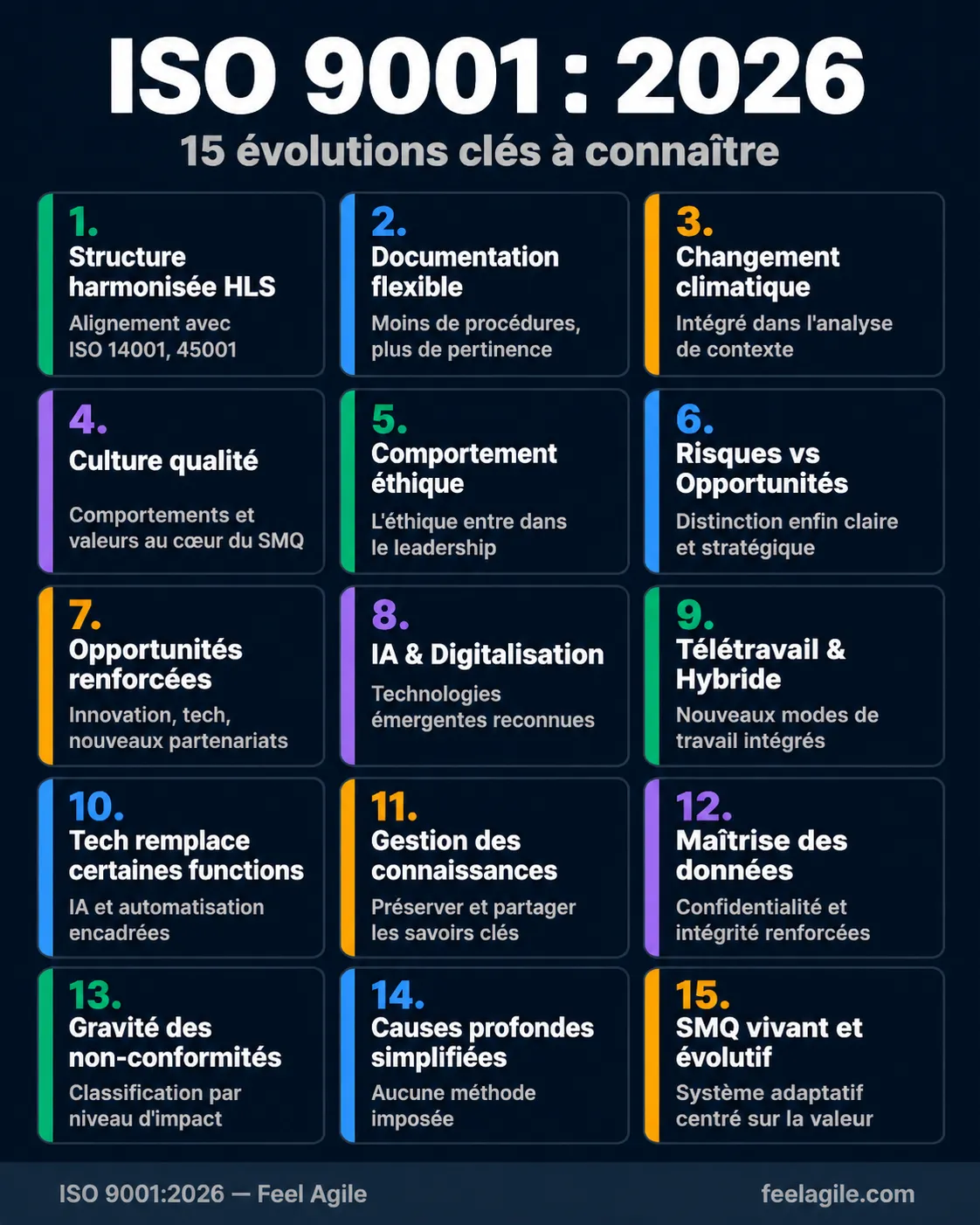
The new version strengthens alignment with ISO 14001 and ISO 45001 through a common structure and terminology. For organizations with multiple certifications, this represents a tangible simplification of overall management.
Key Action: Take this opportunity to explore an integrated management system with our SMI ISO 9001 and ISO 27001 webinar.
The focus is no longer on the number of procedures, but on the availability and relevance of the information required by the QMS. This shift is a natural consequence of the digital transformation of organizations.
Key action: Audit your current document management system and identify what can be digitized or eliminated.
For the first time, the standard explicitly requires organizations to assess whether climate change is a relevant issue for them and to incorporate it into their risk management.
Key action: Formally include this issue in your context analysis, even if you conclude that it does not directly apply to your business.
A culture of quality is becoming a central component of the QMS. The standard emphasizes behaviors, shared values, and collective commitment, going beyond mere formal procedures.
Key Action: Step up your awareness-raising efforts and clarify the quality values championed by management.
The ISO 9001 standard explicitly incorporates the concept of ethics into quality management. An organization’s decisions and practices directly influence the trust of customers and other interested parties.
Key action: Formalize your ethical guidelines and raise managers' awareness of this issue.
This is one of the most significant changes in this version. In 2015, the focus was on risk prevention. Now, the standard also encourages the proactive identification of opportunities, explicitly citing new technologies, new partnerships, and new products.
When it comes to risks, the goal is not to predict everything. Effective risk management is primarily about:
When it comes to opportunities, it’s important to remember that an organization doesn’t progress simply by protecting itself. Every time it develops a new product, invests in technology, or transforms its operations, it is already embracing a mindset focused on opportunity. ISO 9001:2026 formalizes what high-performing companies already do naturally.
Key Action: Revise your context analysis to turn risks and opportunities into a genuine decision-making tool, not just another paperwork exercise.
The standard explicitly acknowledges the growing impact of digital technologies on QMS: digitalization, AI, and the importance of reliable data. Two complementary approaches can be considered:
Key Action: Ensure that your ongoing digital transformations are fully integrated into and managed within your QMS.
The standard recognizes new ways of organizing work as potential sources of risks and opportunities for process control.
Key action: Review your risk assessments, taking into account the specific challenges of remote work.
The standard paves the way for the gradual integration of AI and automation into QMSs, while drawing attention to the associated ethical and liability risks.
Key action: Explore solutions like Oversecur to digitize your QMS.
ISO 9001 places greater emphasis on organizational knowledge: preserving essential knowledge, preventing its loss, and facilitating its sharing. This is a critical challenge in an environment marked by increased mobility and accelerated digital transformation.
Key Action: Define your learning objectives and adopt a results-oriented approach.
The new version emphasizes the protection of documented information in digital environments. It is no longer just a matter of complying with the GDPR: regulations such as NIS 2, DORA, or the Cyber Resilience Act (CRA) are rapidly reshaping the landscape. Companies must implement appropriate solutions, raise awareness among their teams, and demonstrate their level of security.
Key action: Incorporate data-related risks into your analysis and use the ISO 27001 standard as a guide to secure your information system.
The standard introduces the option to classify nonconformities according to their severity, so that corrective actions can be tailored to the actual or potential impact.
Key action: Review your non-conformity handling process to align it with this approach.
The good news is that no specific method is required. Organizations retain the freedom to choose their own tools, which is intended to avoid overly bureaucratic approaches to corrective actions.
Key action: Simplify your analysis process by choosing methods that are truly suited to your context.
ISO 9001 presents the quality management system as a flexible and adaptable system focused on the interactions between processes and continuous improvement. This approach better reflects the reality of modern organizations operating in unstable environments.
Key Action: Reevaluate your system to turn it into a tool that supports operational teams, rather than a compliance mechanism.
The process-based approach remains one of the most valuable contributions of ISO 9001 over the past twenty years, and is often the most poorly implemented. Whereas a purely functional organization tends to operate in silos, the process-based approach allows the company to be managed through its actual workflows: from the customer request to the delivered product or service.
A process always begins with a customer need, whether explicit or implicit. The goal is no longer to have each department operate independently, but to ensure that all activities contribute to creating value. This approach naturally improves coordination, information flow, and the internal customer-supplier relationship among teams.
The classic pitfall: reducing the process to diagrams that are disconnected from reality. Processes must be developed in collaboration with managers and operational teams, based on actual practices, so that they become effective management tools—not documents that no one ever refers to.
The first concrete step is to conduct an assessment of your current system to identify its strengths, overly bureaucratic practices, and necessary changes. More than just an update to documentation, this transition is an opportunity to reevaluate how your QMS actually supports the organization’s performance.
Here are the key areas to focus on:
The increased emphasis on digital and cybersecurity issues in this version makes ISO 27001 a natural and complementary tool for adding value. There are numerous synergies between the two standards, which are detailed in our webinar dedicated to their integration.
Upcoming LIVE events:
Your ISO certification project deserves personalized support. Let’s take stock of the situation together.
Let's discuss your ISO project →