Upcoming webinar: "ISO 27001 in 90 Days: No Hiring, No Wasting Your Time" — Wednesday, September 30, at 2:00 p.m.
Sign up


A request for proposals requiring ISO 27001 certification. A strategic client demanding proof of compliance. An NIS2 audit on the horizon. These situations are becoming increasingly common, and they all raise the same question: where do you start, and how can you ensure that the process is truly successful?
Whether you're a CISO, CIO, or executive, this article provides a clear and practical overview of ISO certifications: what they cover, why they matter, and how to approach them effectively.
An ISO standard is an international framework of best practices published by the International Organization for Standardization. It sets out the requirements that a management system must meet to achieve a specific objective, such as information security, quality, IT service management, artificial intelligence, and more.
ISO certification is a formal attestation issued by an accredited certification body ( Bureau Veritas, AFNOR Certification, SGS, etc.) confirming that an organization effectively meets these requirements, following an independent audit. It is valid for three years, with annual surveillance audits.
In short: the standard is the set of specifications. Certification is proof that you are following it—proof that you can present to your customers, partners, and regulators.
Motivations vary depending on the individual, but they all point to the same tangible benefits.
For business:
For governance and compliance:
For teams:
There is no single universal ISO certification. The choice of standard depends on your industry, your regulatory requirements, and your strategic objectives.
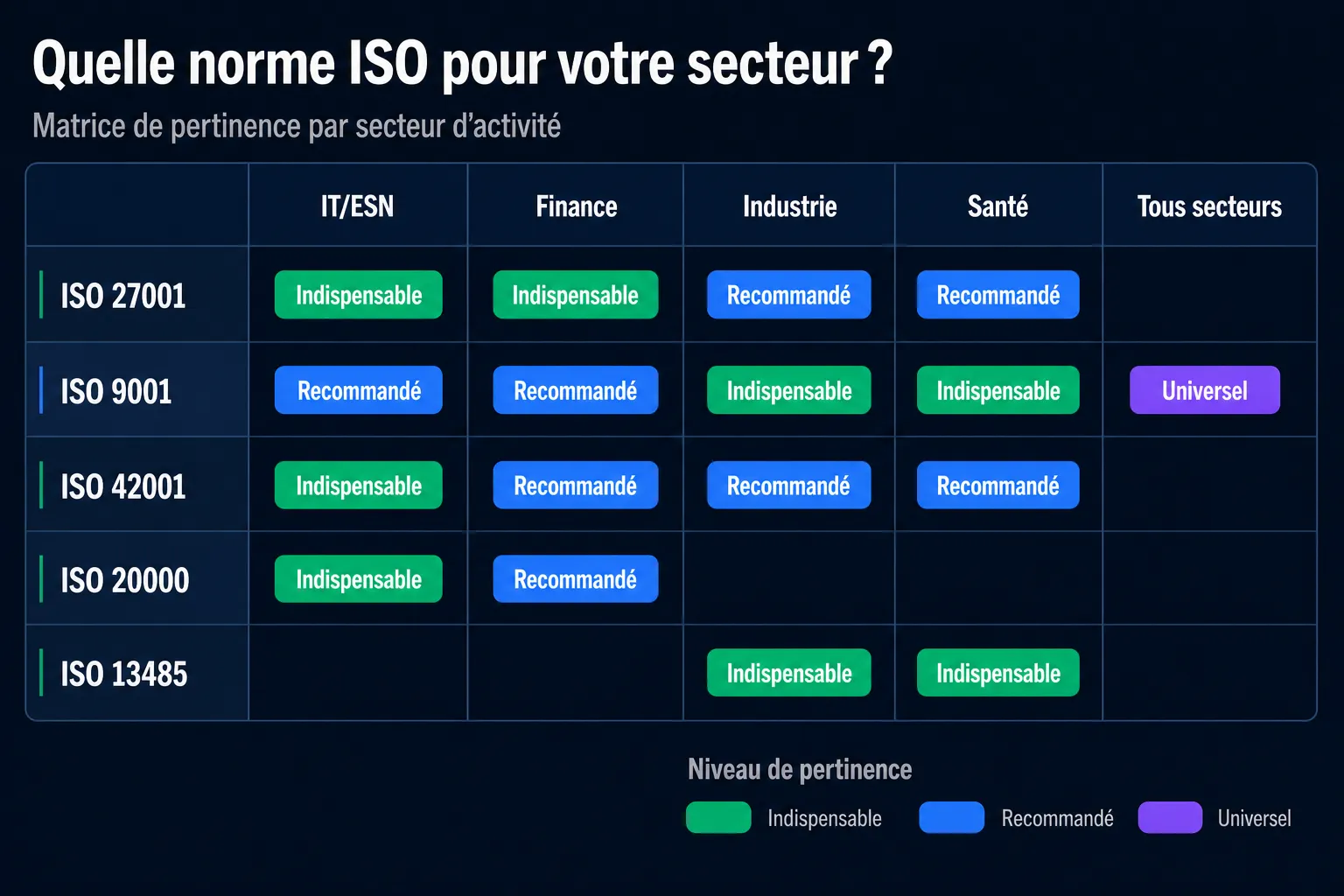
The gold standard for information security management. Essential for digital service providers, software vendors, financial institutions, and any organization that handles sensitive data. The 2022 version includes updated controls for cloud security, threat intelligence, and identity management.
Direct regulatory compliance with NIS2, DORA, and the GDPR.
The AI governance standard published in 2023, developed in response to the European AI Act. It provides a framework for risk assessment, transparency, and traceability of AI systems. It is essential for any organization that develops, integrates, or deploys AI in its products or business processes.
The most widely used ISO standard in the world, applicable to any organization. It structures processes around customer satisfaction and continuous improvement, and is often the first standard an organization obtains before expanding to more specialized standards.
The standard designed for CIOs and managed service providers. It requires rigorous management of incidents, changes, service levels, and IT continuity. It complements ISO 27001 for IT-centric organizations.
Mandatory for manufacturers and distributors of medical devices under the European MDR. It covers quality and traceability throughout the entire product lifecycle.
Other standards tailored to your specific needs: ISO 22301 (business continuity), ISO 14001 (environment/ESG), ISO 45001 (occupational health and safety).
There’s no one-size-fits-all answer, but here are some signs that it’s time to take action:
A well-managed ISO certification process follows five structured steps. The duration and intensity of each step vary depending on the standard being pursued and the maturity of your organization, but the sequence remains the same.
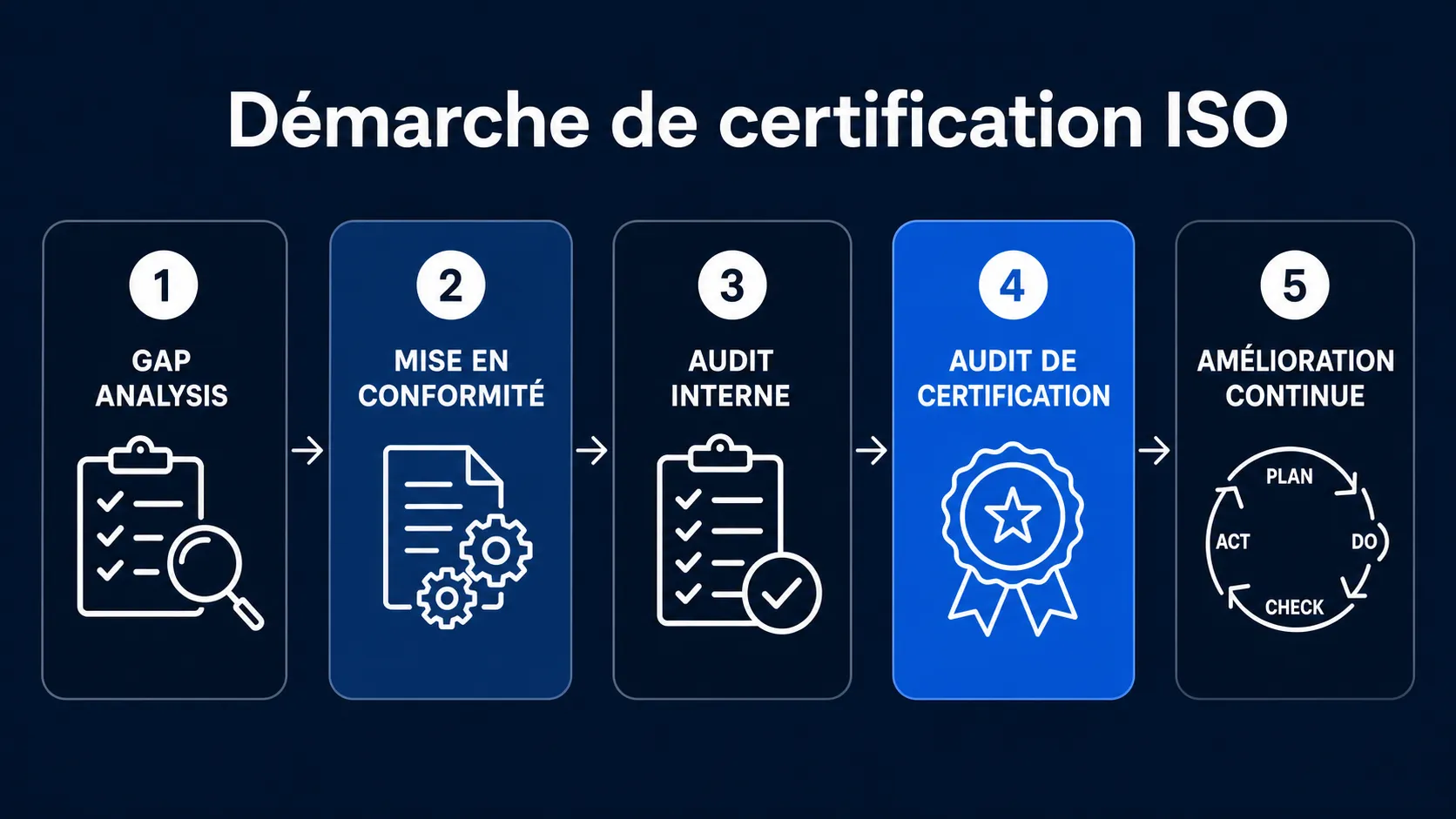
A gap analysis is an essential starting point. It involves carefully assessing the gap between your current practices and the requirements of the target standard, area by area.
In practice, this involves a series of interviews with your key teams, a review of your existing documentation (policies, procedures, contracts), and an analysis of your current technical systems. The deliverable is a maturity report that includes a score for each area and a remediation plan prioritized based on risk level and estimated effort.
This is the most critical step: a sloppy gap analysis leads to costly rework during the compliance phase and surprises during the certification audit.
This phase constitutes the operational core of the process. It involves several teams working in parallel and covers two complementary aspects.
From an organizational perspective: drafting and approving policies, defining roles and responsibilities (RACI), establishing governance bodies (steering committee, executive reviews), and formalizing risk and incident management processes.
From a technical standpoint: according to the standard, this may include implementing security controls (ISO 27001), structuring quality processes (ISO 9001), formalizing IT service management workflows (ISO 20000), or ensuring traceability throughout the product lifecycle (ISO 13485).
Expert guidance at this stage helps avoid excessive documentation—a common pitfall in the early stages of ISO certification: the standard requires evidence, not volume.
Before your organization undergoes an audit by an external auditor, an internal audit simulates the actual conditions of the certification audit. It is conducted by internally trained auditors or an external service provider, based on the standard’s complete set of requirements.
The goal is twofold: to identify any remaining non-conformities before the big day and to train your teams to answer an auditor’s questions. Any gaps identified are addressed through a corrective action plan before moving on to the next step. Failing to conduct this internal audit is one of the main reasons for certification failure or postponement.
The certification audit is conducted in two distinct phases by an accredited certification body (COFRAC in France).
Phase 1 is a document review: the auditor reviews your policies, procedures, and records to verify that the management system is properly designed and documented. It is typically conducted remotely.
Phase 2 is the on-site audit: the auditor verifies the effectiveness of the implementation, interviews the teams, observes practices, and tests the controls in place. The findings are categorized as major non-conformities (blocking), minor non-conformities (to be addressed within 90 days), or observations. If there are no major non-conformities, certification is granted for a period of 3 years.
Obtaining certification is not just a box to check. It is part of a PDCA cycle (Plan, Do, Check, Act) that requires active, ongoing management.
In practice, this involves annual surveillance audits by the certification body, regular management reviews, monitoring of the management system’s performance indicators, and addressing internal nonconformities. The triennial renewal requires a full recertification audit.
It is at this stage that the value of ongoing support becomes fully apparent: maintaining ISO certification over the long term requires a well-established organization, appropriate management tools, and trained teams.
The timeframes and budgets for ISO certification depend on three factors: the standard being pursued, the size of the organization, and its initial level of maturity.
Cost items to anticipate:
Expert guidance that is well-structured from the outset helps reduce the amount of internal time required and avoid audit non-compliance issues—two major causes of budget overruns.
At FeelAgile, we support CISOs, CIOs, and executives in their ISO certification processes across multiple standards: ISO 27001, ISO 42001, ISO 20000, ISO 13485, ISO 9001, as well as TISAX, DORA, and GDPR.
Our approach is practical and results-oriented:
Certification is meaningless without internal adoption. Raising awareness and training your teams—whether technical or business-focused—is what transforms a one-off project into a sustainable culture of compliance.
Available training and awareness programs:
Every ISO certification process is unique. It depends on your industry, your regulatory requirements, and your level of maturity. The sooner you define the scope, the sooner you’ll see tangible benefits. Ready to assess your current situation?
Your ISO certification project deserves personalized support. Let’s take stock of the situation together.
Let's discuss your ISO project →