Upcoming webinar: "ISO 27001 in 90 Days: No Hiring, No Wasting Your Time" — Wednesday, September 30, at 2:00 p.m.
Sign up


A new European regulation is issued, a client requests certification, an audit reveals a vulnerability—and suddenly, regulatory compliance becomes an urgent priority on your desk. Whether you’re a CISO, DPO, or executive at an SME or mid-sized company who has recently faced this reality, one question keeps coming up: Where do you start?
This article provides a clear definition, an overview of the requirements that apply to your business, and a method for structuring your compliance process.
Regulatory compliance refers to the set of legal, normative, and industry-specific obligations that a company must meet in order to operate lawfully. It encompasses binding legal texts (laws, European regulations) and voluntary standards that, in practice, have become essential for accessing certain markets.
In practical terms, regulatory compliance means:
This compliance differs from mere “legality” in that it is an ongoing process: simply complying with the law at a given point in time is not enough; an organization must demonstrate that it maintains this standard over time through documented processes, regular audits, and traceability of decisions. It is this requirement for ongoing evidence that distinguishes a compliant company from one that is merely “in good standing” at the time of an audit.
Compliance does not operate in isolation. It is intertwined with governance (who makes decisions, who steers the process) and risk management (which scenarios to anticipate, how to address them). This three-pronged approach, known by the acronym GRC (Governance, Risk, Compliance), now underpins the majority of corporate initiatives, particularly through dedicated software tools.
The regulatory landscape has become significantly more complex since 2016. The GDPR paved the way by establishing a strict framework for personal data. NIS2 expanded the scope of mandatory cybersecurity requirements to include thousands of entities deemed critical or important. DORA did the same for the financial sector. More recently, the AI Act was enacted to regulate the use of artificial intelligence in business.
This acceleration is no coincidence: it reflects a European commitment to securing critical infrastructure, protecting citizens, and strengthening digital sovereignty.
Failing to comply with regulatory obligations exposes the company to several types of risks:
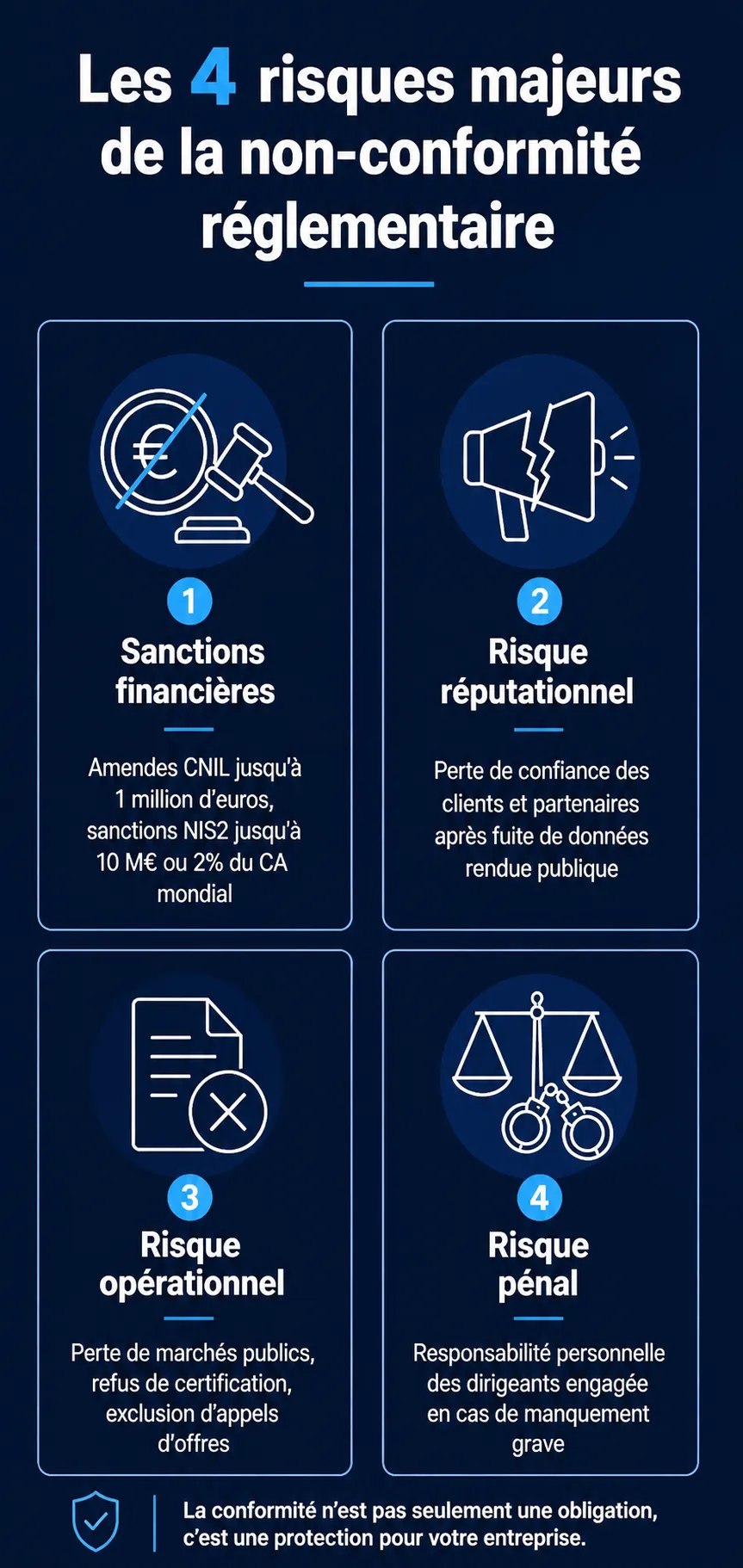
Beyond brand image, reputational risk has measurable consequences: a longer sales cycle, stricter contractual requirements from existing customers, or even the termination of contracts that include a compliance clause. In regulated sectors such as healthcare or finance, a compliance incident can also trigger an in-depth audit by regulatory authorities, with operational impacts that far exceed the initial penalty.
Compliance isn't just a requirement. It has become a genuine selling point in sectors such as healthcare, finance, and defense, where certifications determine access to government contracts and major clients. Displaying an ISO 27001 certification or a SecNumCloud qualification reassures your prospects and sets your offering apart from the competition.
More and more companies are incorporating compliance criteria into their supplier selection processes. A security questionnaire, a request for proof of ISO 27001 certification, or a contractual clause requiring compliance with the GDPR are becoming standard steps in B2B requests for proposals, particularly in highly regulated sectors (banking, insurance, healthcare, and the public sector). Failing to anticipate these requirements can disqualify a company as early as the pre-selection phase, regardless of the quality of its commercial proposal.
The GDPR, the French Data Protection Act, and the CNIL’s recommendations govern the collection, processing, and retention of personal data. This is often the first compliance initiative a company must tackle.
NIS2, DORA, the Military Programming Act (LPM), and the REC Directive structure cybersecurity requirements based on the sector and the criticality of the entity in question.
These regulations share a common rationale: to hold executives accountable for cyber risk management, to require prompt reporting of incidents to the relevant authorities, and to mandate a detailed mapping of critical systems. NIS2 marks a significant shift by expanding its scope to sectors that were previously largely unaffected, such as waste management, the agri-food industry, and certain mid-sized digital service providers.
Certain sectors require specific standards: healthcare (HDS, PGSSI-S), finance (DORA, ACPR), or digital sovereignty (SecNumCloud).
The ISO 9001 (quality), ISO 27001 (information security), and ISO 42001 (AI management) standards provide a framework for internal processes and reassure partners regarding the organization’s maturity.
SOC 2, the CSRD (non-financial reporting), and the duty of care round out the picture, particularly for companies subject to international requirements or corporate social responsibility obligations.
Not all companies are subject to the same requirements. A very small service-sector business will not have the same obligations as a medium-sized industrial company or a financial institution. Several factors determine the applicable regulatory scope:
SMEs and mid-sized companies have long underestimated their regulatory exposure, assuming that major regulations apply only to large corporations. NIS2 changes this equation by directly including thousands of mid-sized companies within its scope. For these organizations, the challenge is not to implement everything immediately, but to prioritize obligations based on actual risk and legal deadlines—often with limited internal resources.
Navigating this complex regulatory landscape on your own is a challenge, especially for teams that are just discovering the full scope of their obligations. FeelAgile supports companies at every stage of their compliance journey: mapping obligations, conducting audits, developing action plans, and providing ongoing guidance.
Your regulatory obligations are changing. Let’s work together to identify your compliance priorities.
Let's discuss your compliance →